
For frontier & deeptech companies, Series A is the double bank shot. You have to prove the product works, and prove it works well enough that a real customer will commit.
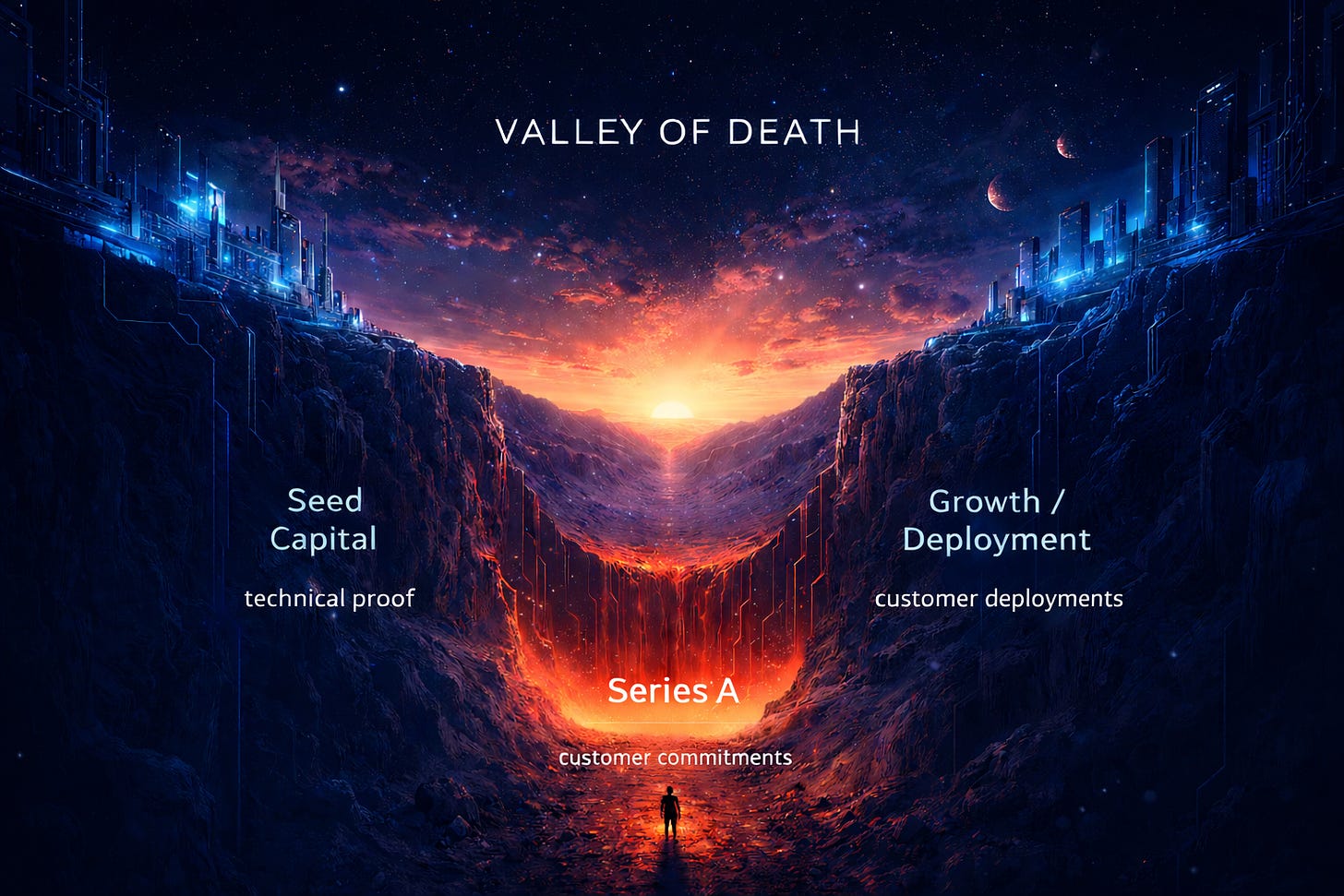
Most Investors Underwrite the Wrong Risk in Frontier Series A
The hardest part of a frontier Series A is not that the technology is too early.
It is that a growing share of Series A capital is still using SaaS-style product and traction mental models to underwrite companies.
But for many frontier companies, the real bottleneck is deployment risk: manufacturing, reliability, qualification, integration, procurement, service burden, and the ability to turn technical credibility into real customer commitments.
That mismatch is where a lot of good companies get stranded.
Seed can fund scientific possibility. Later capital can fund visible deployment. Series A has to fund the messy conversion in between, where the product is technically real but not yet trusted enough for a customer to commit or for the next capital pool to underwrite scale.
That is the real Valley of Death.
And it matters more now because AI has accelerated the formation of frontier companies across compute, defense, energy, industrial systems, and infrastructure. More teams are reaching technical credibility faster. But integration, qualification, procurement, and deployment still move on physical-world timelines. The result is a widening gap between what founders need to prove and what many Series A investors know how to underwrite.
What has to be true
A frontier Series A gets interesting when four things are true.
First, the technology is real enough. The product has moved beyond scientific possibility. The remaining work is mostly engineering, reliability, and deployment.
Second, customer commitment is real enough. You can point to the milestone that makes a real buyer willing to qualify, pilot, design in, pre-purchase, or commit budget.
Third, the economics are real enough. The model gets stronger with scale, payback is legible, and the company can become a strong business rather than an expensive project.
Fourth, the team is credible enough for the next gap. Not just to invent the product, but to get it across the next bottleneck.
If one of those is weak, the round usually gets hard.
Frontier is not just deep tech
A quick distinction matters here.
Deep tech usually describes the underlying technical difficulty: hard science, long R&D cycles, hardware, novel engineering.
Frontier is broader and more useful for founders. It includes deep tech, but also the harder problem that comes after invention: deployment, integration, procurement, capital formation, and where value accrues when a new system collides with the real world.
That is why this post is about frontier Series A, not just deep tech fundraising.
The hard part is usually not just building the thing. It is getting it close enough to customer reality that the market can trust it.
Where value accrues
When the bottleneck shifts from invention to deployment, value does not automatically accrue to the company with the most elegant science.
You can see it in defense. The valuable company is not just the one with a clever missile concept. It is the one that finds a corner of the trade space others missed, proves the math through independent technical assessment, hits the required price point, and becomes the only credible option in a class of system. That is when a technical program starts to look like a category of one.
You can see it in semiconductor. The breakthrough is not “more memory” in the abstract. The value accrues if a company can turn a real technical breakthrough into a manufacturable, integrated product that actually survives packaging, yield, thermal, and supply-chain reality within the timeframe that meets the customer where they need to be.
That is the actual separation.
Not between good science and bad science. Between technologies that are impressive and companies that can become unavoidable.
What founders think they are saying, and what investors hear instead
A lot of frontier Series A rounds break because the founder thinks they are telling a story about progress, while the investor is listening for proof.

The reality is, most companies are doing too much. Early stage companies do not die from starvation. They die from indigestion: too much complexity, too much capex, too much integration pain, and too little room for error.
The founder blueprint before you raise
Before you start a Series A process, you should be able to answer these questions in plain English.
Not in deck language. In underwriting language.

If your answers are vague, the round is probably too early. If your milestones do not map to customer action, it is still a seed story.
The technical questions that actually matter
As you double click, the Series A is not just about proving the product works. It is about proving the product still works once reality gets involved.
That means founders need strong answers to questions like:
- Does the system still work outside the demo?
- What degrades first at scale?
- How much tuning or human intervention does it actually require?
- What part of the advantage disappears once you include integration, ruggedization, certification, or deployment burden?
- Can it be manufactured repeatably, not just demonstrated once?
- How sensitive is performance to real-world variation?
- What technical assumption is doing most of the work in the story?
- Is this now an engineering problem, not an open science problem?

Founders often underweight this because the demo is compelling. Investors often overweight it because this is where many frontier systems break.
Customer commitment is the real milestone
One of the most common errors in frontier fundraising is using vague customer enthusiasm as proof of readiness.
Customer interest is cheap. Customer commitment is expensive.
Meetings are not commitment. Pilots are not always commitment. What matters is whether the next milestone makes a real customer action rational.
A strong Series A should be able to say, with specificity, what customer behavior changes once the next threshold is crossed.
That might mean:
- a paid pilot with defined success criteria
- a qualification program with named milestones
- a design-in or development agreement
- a pre-purchase, reservation, or conditional volume commitment
- a budgeted deployment path tied to clear specs and delivery terms
The right question is not “do customers like this?”
It is “what will a real buyer actually do once we clear the next trust threshold?”

A lot of founders try to bridge this gap with LOIs. That can be useful, but only when the LOI contains real commercial and operational substance. Most do not.
If you say you have $500 million of signed LOIs, that sounds impressive. In many cases, it means very little. A non-binding one-page LOI with no money attached, no target specs, no milestones, and no pricing is usually just a low-cost expression of interest in a future capability.
Fallacy of LOIs
If your LOIs do not cost the buyer something, they usually mean: if you someday build the thing, call us.
That is not customer commitment. It is low-cost future interest.

The key test is simple: does the customer proof make commitment more real, or just interest more legible?
Why unit economics matter earlier than founders think
A lot of frontier founders treat unit economics as a later-stage question. That is a mistake.
At Series A, investors do not need fully mature economics. But they do need evidence that the economics improve in a way that creates real operating leverage. Proof there is a business here.
If the model scales linearly or sub-linearly, has unclear payback periods, requires high capex, or leaves too little room for error, the company can still be technically real and commercially weak. If you modeled it on perfect assumptions, the entire model comes into question.
That is especially true in frontier markets because reality is almost always more expensive and slower than the model.
Founders need to be able to answer questions like:
- Which costs actually come down with scale, and why?
- Does capex unlock a structural advantage, or just more revenue with the same fragility?
- How sensitive is payback to delay, utilization, cost overruns, and deployment friction?
- What has to be true for the next capital layer to underwrite the asset?
- Do early deployments already show positive or near-positive contribution economics?
The key question is not just whether the product works. It is whether each deployment makes the business stronger.

What we look for at the frontier Series A
At this stage, we are not just asking whether the technology is impressive. We are asking whether this can become the trusted system sitting at a real bottleneck in an important market.

If a founder cannot answer these points clearly, the Series A story is probably still too early or too soft.
Closing
The real challenge in a frontier Series A is not simply proving the technology is impressive.
It is proving that the next dollars turn technical credibility into trusted deployment, real customer action, durable economics, and a company that can actually capture the value it creates.
That is the gap many investors still underwrite poorly.
And that is the gap we care most about.
If you are building in AI infrastructure, defense, energy, compute, or industrial systems, and your Series A is really about crossing that gap, we would love to meet you.