
I’ve been spending a lot of time thinking about the next phase of a familiar parallel tension: while automation can displace certain types of work, technology also has the potential to drastically augment humans and create entirely new markets when thoughtfully directed.
We’ve seen and read about this dynamic before: the industrial revolution, the internet, and recent history – Uber didn’t just replace taxis; it activated a flexible labor pool that hadn’t been utilized at scale. Airbnb didn’t cannibalize hotels so much as it unlocked millions of underused homes and rooms. These didn’t eliminate jobs, they restructured who could participate in the economy and how.
AI is again causing us to think deeper about the creation of new modes of economic participation. Not because automation itself is new, but because this wave of automation is not confined to a narrow set of tasks or industries. It is broad, fast-moving, and right now, unevenly distributed across the labor force. It has caused the traditional organizational pyramid, supported by a wide base of junior roles that fed talent upward, to collapse.
Pyramids are shifting to diamond-shaped structures as workforces prioritize more experienced, senior roles. Diamonds are becoming flat lines as mid-level management disappears; and in some cases, lines collapse into single, highly leveraged roles with one person armed with an AI stack doing what once took a fleet of people. As AI absorbs routine decision-making, the hierarchical layers that once justified large teams with hefty entry-level classes are dissolving. Elsewhere, they are giving way to hourglass structures, with strategy and execution expanding while the middle thins, enabled by AI agents rather than management layers. CEOs are pushing their management teams to see what they can accomplish with AI tools first before posting new JDs on LinkedIn. Regardless, traditional pyramid structures are increasingly looking like outdated, expensive relics of a pre-AI era.

The Uncomfortable Truth for Venture Capital
The reality is that we, across the VC ecosystem, will play a meaningful role in shaping how labor markets evolve. Three questions weigh on me the most right now:
- First, what will the future of our labor force look like?
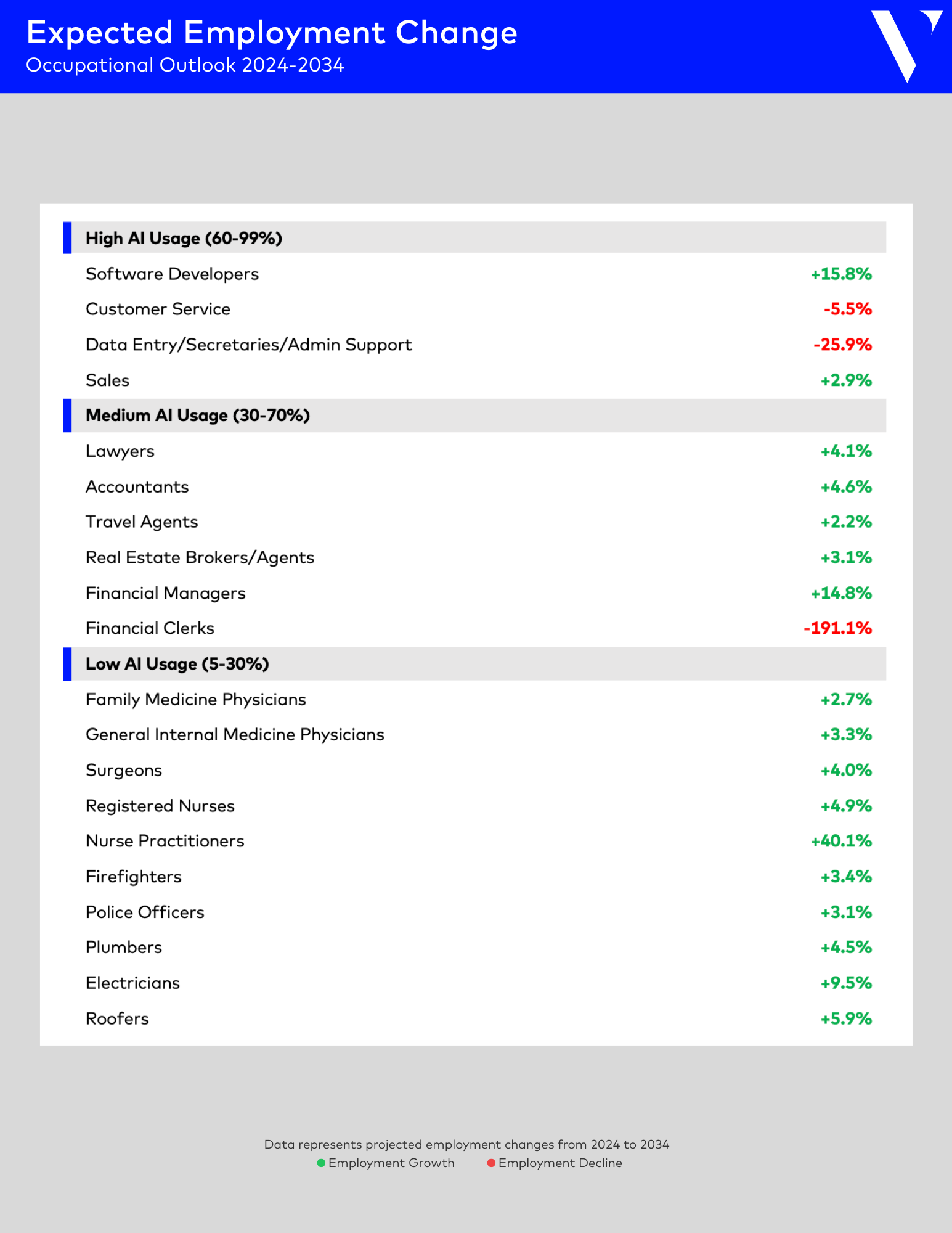
- Two, what kinds of jobs get created as others disappear? We’re already seeing familiar roles, like customer service, start to fade [see table below].(1)
- And third, what new technologies will help fuel this transition?
The Next Generation of Workers
What is well known is that GenAI is disproportionately impacting entry-level workers, particularly young software developers aged 22-25, while older peers in the same roles are less affected.(2) By contrast, in fields where AI is augmenting rather than replacing labor, such as in healthcare, nursing, and skilled trades, young workers are holding steady or even seeing employment growth. The divergence suggests that when AI increases human leverage instead of substituting for it, labor demand can expand rather than contract.
The broader concern is the erosion of entry-level roles themselves; roles that have historically served as critical on-ramps for skill development and upward mobility. As those rungs disappear, the career ladder risks breaking altogether, raising urgent questions about what new pathways will emerge. While AI investment is accelerating regardless, the most affected group today – young software engineers – may also be best positioned to adapt and create what comes next. The greater challenge might come when automation spreads to workers with fewer built-in avenues and toolkits for reinvention.
Automation’s Second Act
If GenAI is quietly hollowing out white-collar work, my working hypothesis is that advances in robotics will deliver the louder shock. While robotics will unlock some of the largest gains for factory and construction operators, including lower OpEx, higher throughput, and improved yields, the labor implications might be more severe. The prevailing assumption, broadly speaking, is that physical labor is insulated from AI because it has historically been harder to automate, but in practice it may be more exposed. As perception and reinforcement learning improve, manual roles centered on highly repetitive physical tasks will feel the impact of automation.
This is likely to begin with high-volume, repetitive work in environments such as palletizing, welding, pick-and-place operations, and basic quality inspection. Over time, it will extend into field roles where sensing, connectivity, and autonomy are improving, including parts of logistics, mining, agriculture, and construction. This, of course, does not include all types of work. By contrast, work that is highly variable, interpersonal, or demands fine-grained dexterity is likely to remain human-centered.
Along with job displacement in white-collar roles, workers in these exposed blue-collar roles will require meaningful support to transition into adjacent jobs, reskilling pathways, or entirely new forms of employment. I believe new technologies can help enable that shift, but the scale and speed of change will demand intentional effort rather than passive adaptation.
Labor-Native AI
The next generation of technology companies cannot just automate tasks; they must also help guide workers through displacement, pertain knowledge of human aptitude, repurpose existing skills, and create credible pathways into new forms of work.
Companies like Mercor offer a small glimpse of what this can look like. Mercor exists because advanced AI systems still require high-quality human judgment for annotation and oversight. By structuring and scaling human work, it turns a byproduct of AI development into a durable labor market.
And what this looks like in practice is not a wholesale replacement of human labor, but a reconfiguration of it. Consider a remote construction operator: instead of sitting on-site, a machine operator logs in from home, connects to a digital twin of a job site, and controls excavators, cranes, or dozers via joystick. The AI handles low-level control, stability, and safety aspects, while the human focuses on judgment calls such as task sequencing, proximity to utilities, and edge cases the model cannot resolve. The role looks less like traditional heavy equipment operation and more like a blend of esports athlete and site supervisor.
Training for these roles will increasingly happen in game-like simulation environments. New operators learn through missions, levels, feedback loops, and leaderboards, all built on the same control stack that runs real equipment. Skills transfer directly from simulation to the physical world, and at some point the system can seamlessly swap between the two. An operator may not even know whether a given shift is real work or training data collection.
Ultimately, we need a new framework to categorize these companies. Perhaps, let’s call it “labor native AI.” These are systems designed from day one with human participation as a first-class primitive, not as an afterthought. Labor-native companies don’t just ask “what can be automated?” Instead, they ask “what new human roles become viable once intelligence no longer is the bottleneck?” The smartest AI companies today avoid directly threatening companies’ employees or business models. They start by helping existing firms operate more effectively, using augmentation to earn trust before driving deeper change.
An Invitation to Builders
The key insight: the safest jobs are not the ones AI can’t touch. They’ll be the ones that only exist because AI does.
AI’s impact on labor is no longer abstract. It is unfolding quietly and unevenly. It’s unfolding quietly inside real systems: factories, logistics networks, energy infrastructure, data centers, and industrial operations that are being forced to change how work gets done. As automation and intelligence move from screens into physical environments, entirely new categories of work will emerge alongside them and technology-enabled workforce repurposement will become essential.
As an investor, I find myself spending more time listening to people who are thinking carefully about these transitions…founders, researchers, and operators trying to understand how work itself is being reshaped. If we get this right, AI will broaden economic participation and create new markets.
As we are going into 2026 and beyond, we’re looking for founders who are thoughtfully building in the future of work. We hope to engage with other builders, operators, and investors who likewise share this philosophy.
(1) At the same time, these jobs offer a useful case study in how AI reshapes work in more subtle ways than solely productivity gains. Research suggests that AI can even improve the day-to-day experience of work, with customers becoming more polite and less likely to escalate to a manager when AI tools are involved.
(2) Research from Erik Brynjolfsson, Bharat Chandar and Ruyu Chen.