
From elite law firms and accounting powerhouses to insurance conglomerates and management consulting dynasties, the professional services industry represents a staggering $20 trillion global market.
This massive sector remains dominated by human-driven, low-tech businesses where titans have built their brands on historical reputation and prestige rather than measurable performance. They operate on centuries-old business models, relying on armies of highly paid professionals working through labor-intensive processes that have barely evolved since the typewriter gave way to the word processor.
But that is about to change.
A new wave of AI-native professional service firms is emerging, promising to resegment this $20T industry and relegate the legacy guard to history.
A New Fork in Professional Services History
While many focus on AI making existing software more efficient, the true revolution is happening as AI pushes directly into domains previously exclusive to human experts: strategic negotiations, creative problem-solving, and high-stakes decisions. These critical domains have remained stubbornly resistant to software automation until now.
We’re witnessing a fork that will split the professional services landscape into two distinct futures:
Legacy Professional Services:
- Dominated by established incumbents with century-old processes
- Knowledge siloed by human experts with limited documentation
- Services bottlenecked by human cognitive and time constraints
- Premium pricing models based on artificial scarcity
Elite AI-Driven Professional Services:
- AI-native firms delivering demonstrably superior outcomes
- Expertise amplification across entire organizations
- Services that scale beyond traditional human constraints
- Value-based pricing tied to measurable outcomes
This transformation isn’t about automating existing processes—it’s about fundamentally expanding what’s possible in professional services. We’re witnessing the birth of the next generation of industry-defining brands, built from the ground up to harness AI’s transformative potential.
The Most Vulnerable Service Verticals
While every professional services vertical will be impacted, some are particularly ripe for disruption based on their knowledge-intensive nature, rule-based workflows, and pattern-dependent decision-making.

Combined, these five leading incumbents alone represent over $240 billion in annual revenue and employ more than 900,000 professionals. And they’re merely the tip of the iceberg in their respective industries, representing massive markets ripe for AI-powered disruption.

The subsectors towards the top generally involve more structured data processing and clear rule applications, with the lower still containing significant judgment elements but within well-defined frameworks.
The Five Principles of Elite AI-Powered Service Firms
These new AI-powered service firms operate on fundamentally different principles that combine business innovation with technical capabilities:

These principles fundamentally transform what professional services can be—delivering exponentially better outcomes while operating with software-like margins.
Why Clients Will Embrace AI-Native Professional Services
Why would clients take the risk of moving away from the elite, proven brands to these new emerging AI-native services? The compelling advantages across different market segments will quickly overcome initial hesitation:
For Consumers and Small Businesses
- Democratized Access to Expertise: AI-native firms offer enterprise-grade expertise to all clients regardless of size. Small businesses receive the same quality of advice previously exclusive to Fortune 500 companies.
- Transparent, Fixed Pricing: Predictable, fixed-fee pricing models replace opaque hourly billing, eliminating cost anxiety and making elite services accessible to broader markets.
- Objectively Superior Results: When a new tax advisory firm identifies 40% more deductions or a legal firm wins 30% more cases, reputation becomes secondary to measurable performance.
- Instant, 24/7 Responsiveness: Immediate, high-quality guidance at any hour creates stark differentiation from traditional firms with their scheduling delays and limited availability.
For Enterprise Clients
- Complete Verification Capabilities: AI-native firms provide full documentation of reasoning, allowing executives to verify quality rather than relying on brand reputation as a proxy.
- Comprehensive Analysis At Scale: When AI-native firms analyze 100% of relevant cases, regulations, or scenarios while legacy firms sample only 5-10%, the performance gap becomes undeniable.
- Integration with Modern Operations: As client businesses become increasingly digital, they’ll prefer service providers whose operations integrate seamlessly with their systems rather than firms operating on century-old paradigms.
- Institutional Knowledge Continuity: AI-native firms offer knowledge that doesn’t walk out the door when star practitioners leave, eliminating key person risk that plagues traditional firms.
Trust Accelerators
The transition will accelerate through:
- Human-AI Partnership that preserves client relationships while delivering superior cognitive capabilities
- Process Transparency transforms the traditional black box of professional services into a verifiable glass box
- Empirical Performance Data that makes the superiority of AI-native firms increasingly difficult to ignore
- Heritage Brand Partnerships where legacy firms adopt AI capabilities to create hybrid models
By 2030, AI-augmented service delivery will be the expected standard, with traditional human-only approaches viewed as expensive anachronisms in most professional domains.
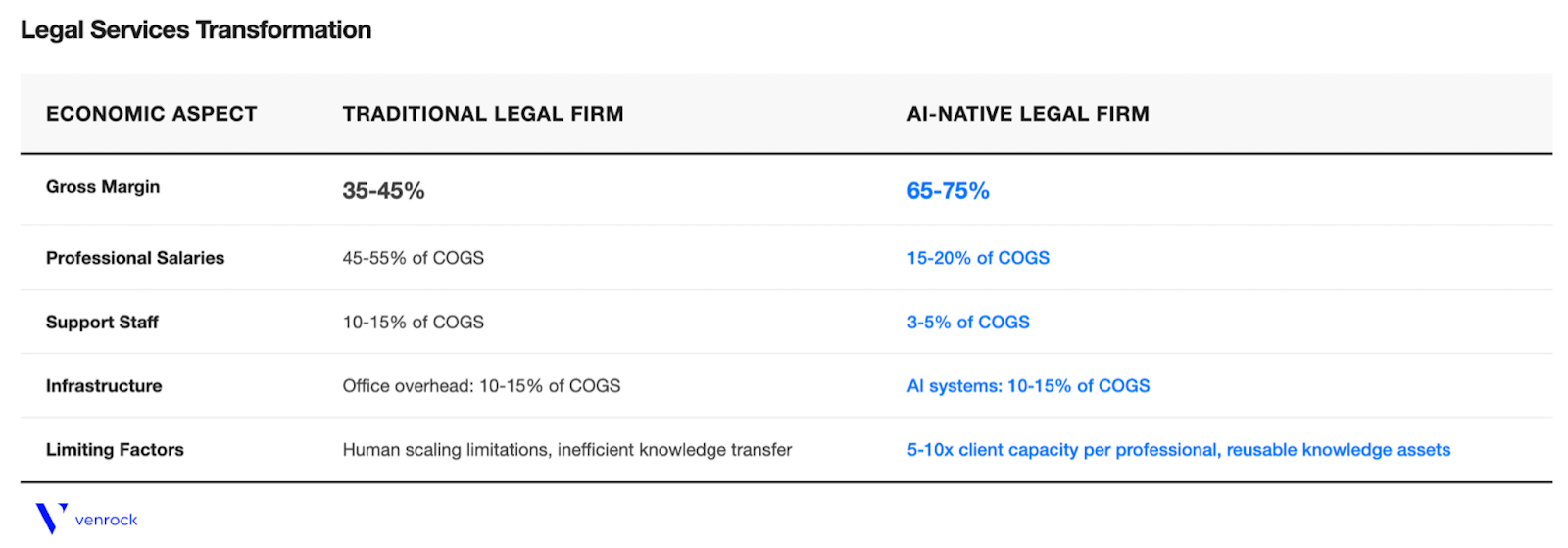
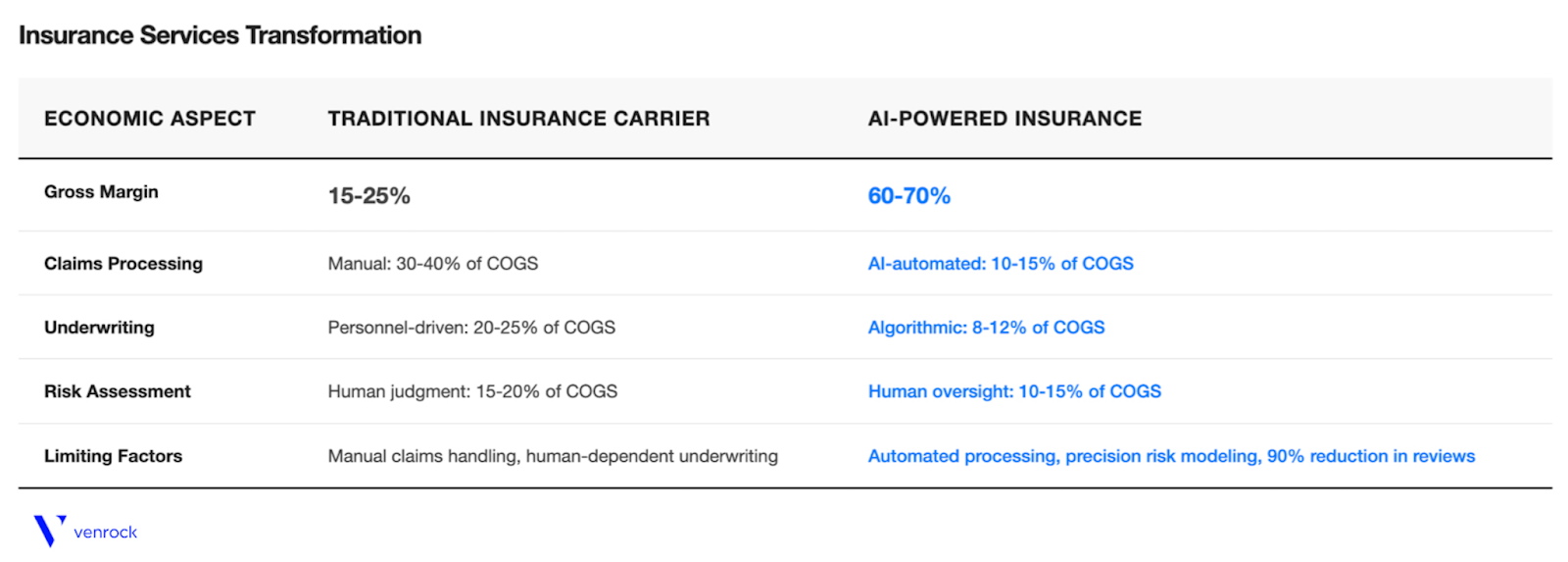
Transforming the Margin Profile: From Services to Software Economics
The economics of professional services are about to undergo a fundamental transformation as AI redefines the cost structure of delivering expertise.
Legal Services
Insurance Services
Wealth Management
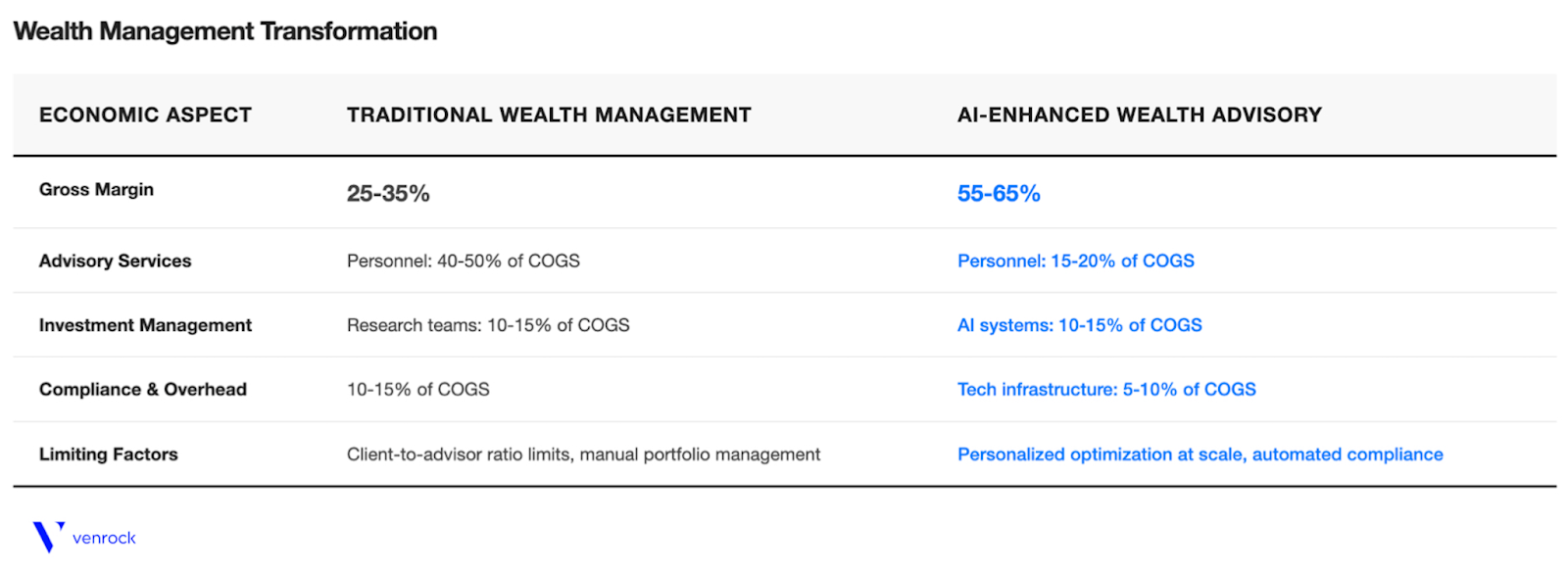
This transformation represents perhaps the largest opportunity in the AI landscape today. For entrepreneurs and investors, the $20 trillion market of pure human expertise is now accessible in ways previously unimaginable.

What makes this moment historic isn’t just technology improvement—it’s a fundamental expansion of human capability. Like software’s transformation of manufacturing, AI will redefine what professional services can be, democratizing access to world-class expertise previously confined to elite firms serving the largest enterprises.
For investors, this represents a multi-trillion dollar opportunity to back the next generation of professional service firms—companies that will redefine excellence in their fields while operating with software-like economics.
The market for pure human expertise is about to be transformed—not replaced, but enhanced, expanded, and elevated to heights we’re only beginning to imagine.
And it’s just getting started.