Google Research just dropped a paper that fundamentally changes how we think about AI architecture, now with AI memory.
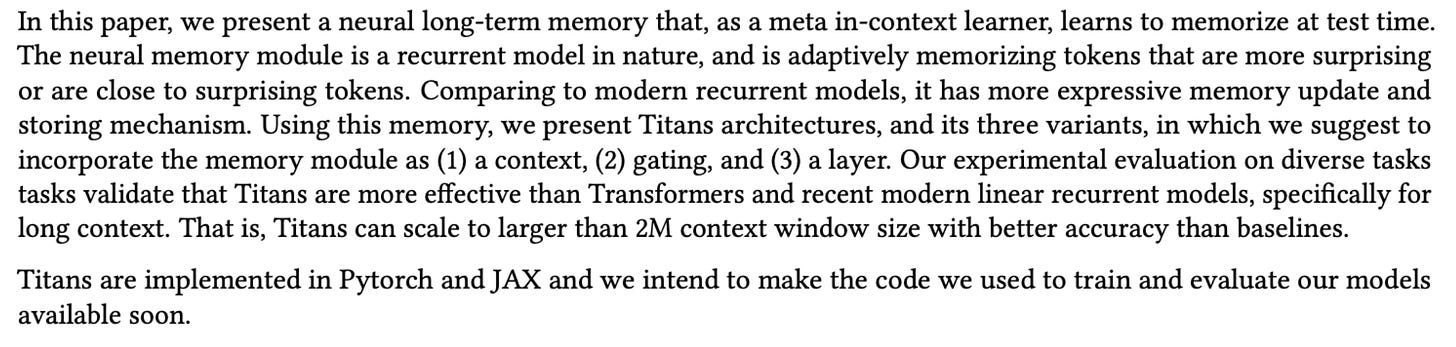
While everyone’s obsessing over model size and test-time compute, Google Research just dropped a paper that fundamentally changes how we think about AI architecture. This isn’t just another research paper – it’s the next Transformer moment, meet Titans. The original Transformer paper solved a fundamental problem: how to process sequences without recurrence. DeepSeek showed us how to make the training of that architecture 90% cheaper. Now, Titans tackles an equally fundamental challenge: how to give AI systems true memory capabilities. And it’s not just another incremental improvement – it’s a complete rethinking of how AI systems remember and process information. Here’s why this matters and what it could unlock.
Why This Changes Everything
Today’s most advanced language models, despite their impressive capabilities, suffer from a fundamental limitation: they can’t truly remember. They can write a novel or debug your code, but they can’t remember what they learned yesterday. Every conversation starts fresh. Every insight gets lost. Current attempts to solve this are all workarounds:
RAG (Retrieval-Augmented Generation) – an anti-pattern that is just fancy search
Vector databases – glorified lookup tables
Extended context windows – expensive band-aids
Sliding window attention – losing most of the context
It’s like trying to build a computer without RAM – you can do it, but why would you? It’s one of the most fundamental limitations in the transformer architecture that is holding back AI today.
What Makes Titans Different
This isn’t just another paper about making models bigger or training cheaper. Titans introduces three fundamental innovations that change the game:
1. True Test-Time Memory: The researchers introduce a neural long-term memory module that’s fundamentally different from traditional approaches. Instead of just expanding context windows or adding retrieval mechanisms, Titans learns to memorize at test time.
Learns what to remember while running
Gets smarter with every interaction
Maintains context across months of use
Actually learns from experience
2. Surprise-Based Memory Instead of trying to remember everything (like RAG) or nothing (like standard Transformers), Titans uses a sophisticated “surprise” metric to determine what’s worth remembering:
Immediate surprise: “This is unexpected”
Historical surprise: “This pattern is important”
Contextual surprise: “This changes what we thought we knew”
3. Adaptive Forgetting The real breakthrough isn’t just in remembering – it’s in forgetting intelligently:
Automatically identifies outdated information
Preserves critical insights while pruning routine data
Maintains memory efficiency at scale
The Technical Leap Forward
Just like DeepSeek showed us training could be 90% cheaper, Titans shows us AI systems can be 100x more capable through memory. Here’s how:
1. Scale Beyond Imagination
Handles sequences >2M tokens long
Maintains linear computational scaling vs quadratic of transformers
Processes more context than GPT-4 and Claude combined
2. Efficient Processing
Parallelizable training algorithm
Fast inference despite deep memory
Intelligent memory consolidation
3. Architecture That Makes Sense Three variants for different needs:
Memory as Context (MAC): For deep understanding
Memory as Gate (MAG): For efficient processing
Memory as Layer (MAL): For easy integration
What This Unlocks
When we think about what becomes possible when AI systems can maintain deep, persistent memory.. these aren’t theoretical use cases – they’re transformative applications enabled by Titans’ specific technical capabilities.
1. The Developer That Never Forgets
“I see you’re modifying the authentication system. We tried this OAuth approach in March – it caused rate limiting issues. Here’s what happened, why it failed, and three better approaches based on what we learned.”
2. The Analyst That Actually Learns
“This market pattern matches what we saw before the 2023 banking stress, but with three critical differences. Here’s why this time is different, based on analyzing every similar situation in the past decade.”
3. The Research Assistant That Builds Understanding
“While these symptoms suggest bronchitis, I’m seeing a pattern in the patient’s history that matches 47 similar cases where the initial diagnosis was wrong. Here’s the complete analysis and what we learned from those cases.”
Why This Is the Next Transformer Moment
Just as Transformers solved sequence processing, Titans solves memory. This means:
1. True Learning Systems
Systems that actually improve with use
Memory that persists and evolves
Understanding that deepens over time
2. Exponential Value Creation
Each interaction makes the system smarter
Knowledge compounds over time
Insights transfer across domains
3. Fundamental Architecture Shift
From stateless to stateful AI
From pattern matching to true learning
From short-term to long-term understanding
What’s Left to Prove
The path from breakthrough research to production AI is well-worn at this point. With Titans, three key things need to be proven before this becomes more than an exciting paper:
1. Memory Economics: While the paper shows linear computational scaling (vs quadratic for transformers), the real costs are still unclear:
How much more expensive is training?
What’s the GPU memory overhead in production?
Can smaller companies afford to deploy this?
2. Memory Reliability: Test-time learning is exciting, but raises hard questions:
How stable is the memory over weeks or months of operation?
What happens when the memory gets corrupted?
How do you safely update or reset memory states?
3. Production Readiness: The paper shows promising results on research benchmarks, but enterprise deployment is another story:
How does memory work in distributed systems?
What’s the story for backup and recovery?
How do you monitor and debug memory issues?
None of these challenges seem fundamental – they’re engineering problems, not research problems. But they’re the difference between an exciting paper and a technology that transforms how we build AI systems. The good news? The AI infrastructure ecosystem is far more mature than when Transformers were introduced. We have the tools, talent, and incentives to solve these challenges. It’s not a question of if, but when.
Looking Forward
This isn’t just another improvement – it’s a fundamental shift in how AI systems work. Just as Transformers enabled the current AI boom, Titans enables the next wave: AI systems that truly learn, remember, and grow. The next generation of billion-dollar AI companies won’t be built on bigger models – they’ll be built on better memory. The future belongs to systems that don’t just process information, but actually learn from experience.
Where real ROI can be delivered by:
Solving memory problems that directly tie to revenue or cost reduction (real ROI in year one)
Building deep moats through accumulated context (the value should compound over time)
Focusing on sectors where context and historical knowledge have enormous value (enterprise knowledge, software development, r&d, operations)
The companies that understand this shift now will define the next decade of AI. The race to build truly intelligent systems just got a lot more interesting. If you’re building in this space, we’d love to hear from you. The future of AI isn’t just about bigger models – it’s about systems that truly remember and learn.